Before the pneumatic drum and the temperature-controlled germination vessel, malting was a matter of hands, eyes, nose, and time. Grain was wetted in wooden vats or wicker baskets, spread on a surface when it had drunk enough water, and watched. The maltster's job was to catch the moment when modification — the breakdown of the grain's protein matrix by its own enzymes — had gone far enough but not too far. There was no thermometer to trust. There was the feel of the rootlet between finger and thumb, the smell coming off the bed, the colour the grain was turning.
The floor maltings that survived into the twentieth century — long, low stone buildings with slate or flagged floors, louvred vents set into the roofline — represent the nearest thing to standardisation this craft ever achieved before industrialisation. But even those were local compromises: the thickness of the grain bed, the frequency of turning, the ambient temperature of a particular building in a particular climate. A Bavarian maltings and a Suffolk maltings were producing grain that behaved differently, and both brewers had adjusted their practice to match.
Go further back, before purpose-built malthouses, and the variation compounds. Archaeological and ethnographic evidence from across northern and western Europe shows grain germinated in fired-clay vessels, in loosely woven baskets that allowed drainage, on hides stretched over frames. The grain was wetted in batches small enough to manage, because even germination requires turning and the surface area of the pile determines how much heat it throws off as the embryo wakes. A pile that heats too hard kills the enzymes you need. Managing that required constant attention — not sophisticated equipment.
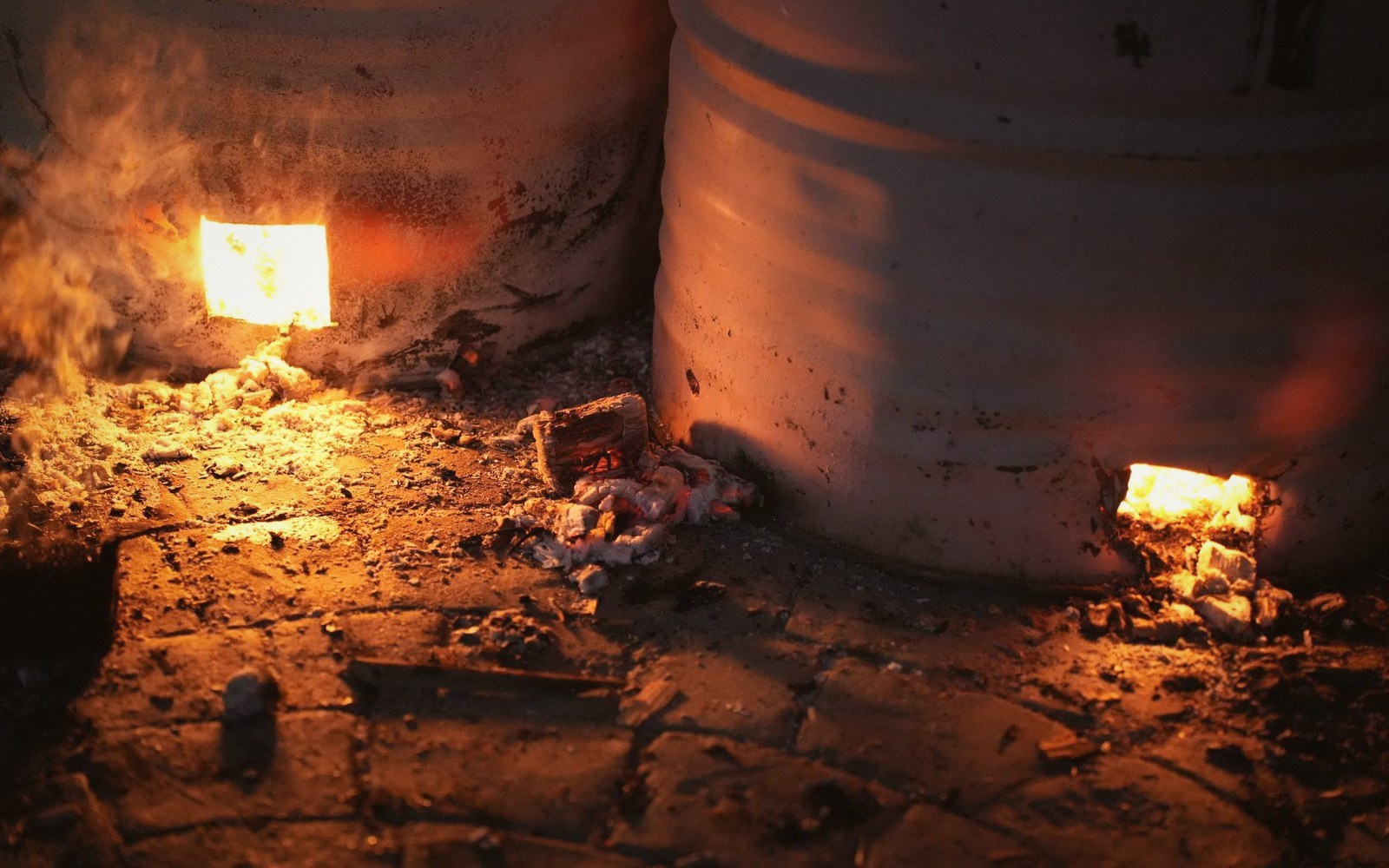
Drying was where character was fixed, and also where most of the risk lived. In pre-industrial practice, drying meant fire. The grain was spread on a surface above a heat source — sometimes a pit kiln, sometimes a tiled oven vented from below, sometimes (particularly in farmhouse contexts) simply spread on a stone surface near the hearth. Direct firing meant smoke, and smoke meant a smoky malt, not as a stylistic choice but as an unavoidable fact of the technology. Almost all malt was smoked before indirect kilning existed; the clean pale malt that now defines most of what we drink is a very recent development, measured against the full span of brewing history.
The control problem was temperature. Drying too fast or too hot destroyed enzymes and produced malt that would not convert starch efficiently. Drying too cool left the grain damp enough to mould in storage. Skilled maltsters calibrated this by feel — hand to the surface, attention to steam rising, judgement about when the grain rattled dry in the hand. The skill was real, and its failure mode was losing the batch.
What industrialisation did, when it arrived across the nineteenth century, was substitute instrumentation and scale for that embodied knowledge. Floor maltings were mechanised, then replaced by tower maltings and pneumatic drum systems where airflow, temperature, and steeping times were recorded and repeated. Consistency became achievable as a technical matter rather than a function of individual expertise. What was lost — or rather, what stopped being the main thing — was the local character that came from a particular water source for steeping, the ambient temperature of a given building's microclimate, the fire material used in drying.
That local variability is not purely romantic in retrospect. Sahti, the Finnish farmhouse ale tradition, maintained a version of small-batch, fire-dried malting into the modern era, and the malt it produces carries a flavour profile that industrial malt simply does not replicate: deeper, less clean, with a residual smokiness and a particular doughy sweetness that comes from uneven modification across the bed. It tastes like what it is — grain watched and turned by hand, dried over a fire, used quickly.
The floor maltings model was the closest thing to a baseline before industrialisation. Everything that preceded it was more variable, more local, and more dependent on a craftsperson's accumulated read of the material. Understanding that is not nostalgia. It is understanding what standardisation costs as well as what it delivers.
What happened, in order
- Pre-industrial eragermination in baskets, vats, or hides; drying over open fire or pit kiln; intensely local and variable
- Floor maltingspurpose-built low stone buildings with louvred vents; spread into standardised use from medieval period; locally adapted but more consistent
- Mechanised floor maltings19th century; instrumentation begins to replace embodied knowledge
- Tower maltings and pneumatic drum systemslate 19th–20th century; temperature, airflow, steeping times recorded and repeatable; industrial consistency
What the maltster could not avoid
- Smokedirect-fire drying made it intrinsic to the product, not a stylistic addition
- Enzyme killdrying too hot or too fast destroyed the amylase needed for starch conversion
- Heat in the bedgerminating grain generates its own heat; a pile too deep or too dense could kill the embryo
- Spoilageunder-dried grain moulded in storage; no safe margin without controlled airflow