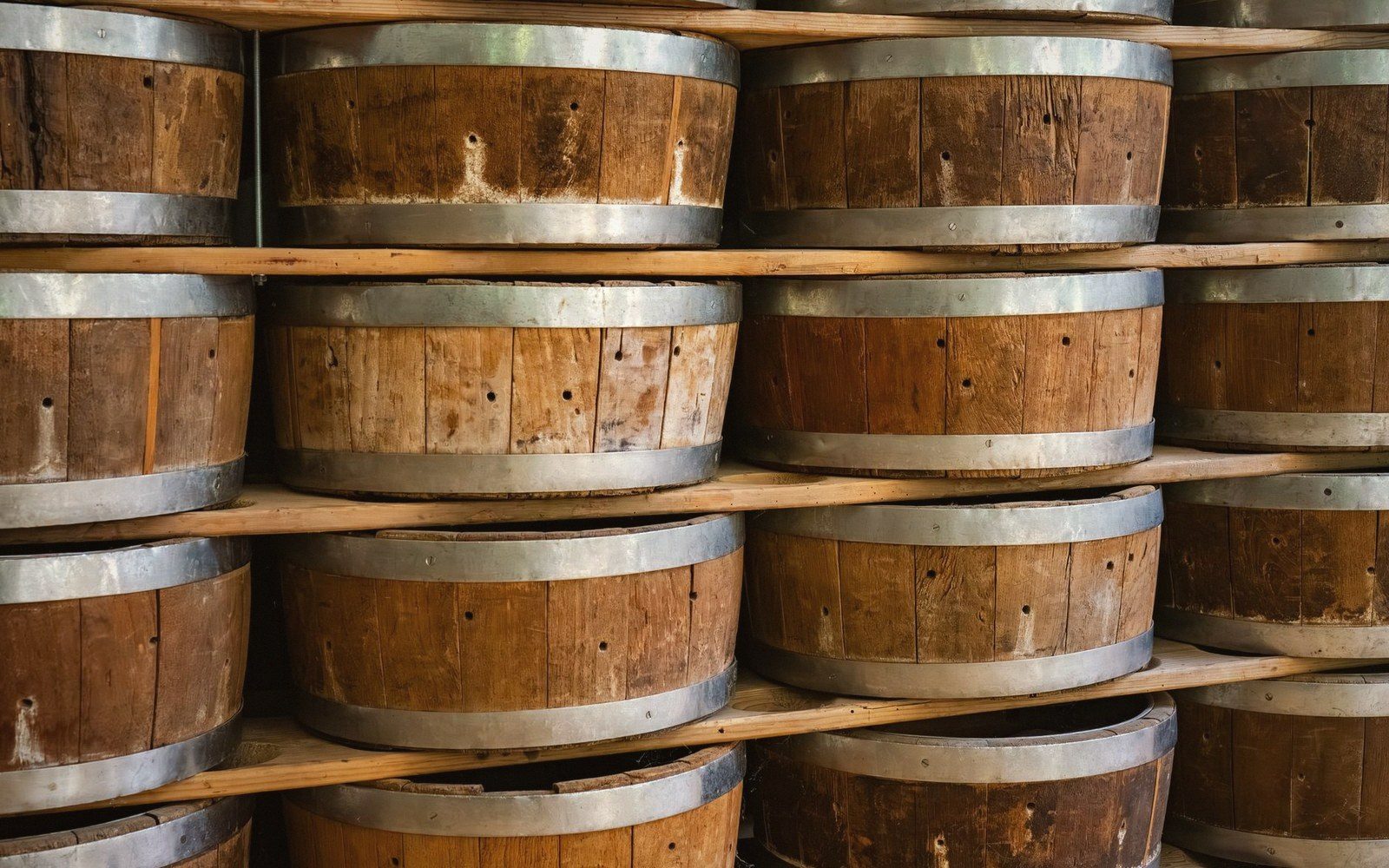
A foeder (a large oak aging vessel, typically holding several thousand liters) is not a container. It is an ecosystem with walls.
Oak is porous at a scale that matters. Where a stainless steel tank offers fermentation a sealed, neutral chamber, oak breathes — slowly exchanging oxygen, leaching tannins and vanillin, and harboring, in its grain and stave joints, a resident population of Brettanomyces, lactic acid bacteria, and wild yeasts that no sanitation protocol fully reaches. The older the vessel, the deeper those organisms have migrated. A foeder worked continuously for thirty or forty years is not just seasoned; it is inhabited in layers, the innermost populations having arrived decades before the current brewer was born.
This is why the microbial character of a mature foeder cannot be meaningfully transferred. You can pitch the same organisms from the same source culture into a new oak vessel, and you will get something different — perhaps dramatically different — because the culture and the wood have co-developed. The tannin load has dropped to near zero in the oldest staves, so the wood no longer fights the biology. The surface geometry of the interior, scarred by decades of scraping and rinsing, has more real area than a new vessel of identical volume. What lives there has adapted to that wood, not to oak in the abstract.
The lambic breweries of the Senne valley have understood this for generations. When a foeder cracks beyond repair, the loss is not primarily financial — it is biological. The organisms inside it are, in a meaningful sense, irreplaceable. Some producers attempt to inoculate new vessels by introducing old stave fragments, the way a sourdough baker reserves a portion of the previous batch. The results are variable. The culture does not transfer cleanly; it reconstitutes, imperfectly, over years.
To inherit a foeder from a closing brewery is therefore a genuinely different transaction from buying new cooperage. The purchaser is acquiring a running fermentation history — a microbial archive whose contents are not catalogued anywhere and cannot be audited before the first brew goes in. The wood remembers what no one thought to write down.
What this produces, in the glass, is character that is specific to time and place in a way that terroir in brewing almost never manages to be. It is not reproducible by intention. It accrues.
What the terms mean
- foederlarge oak aging vessel (typically 3,000–15,000 litres or more); derived from Flemish coopering tradition; distinct from a barrel by scale
- Brettanomycesa genus of wild yeast that produces complex, often leathery or fruity flavor compounds; thrives in porous wood; central to lambic character
- stavethe individual timber plank making up a barrel or foeder wall; microbial populations colonize stave interiors over time
What happened, in order
- New foeder: wood-forward, high tannin, biology not yet established
- After several years of use: tannin contribution falling, microbial layer forming in outer stave grain
- After two or more decades: tannin near neutral, deep microbial colonization, culture fully co-adapted to that specific wood
- At failure or decommission: interior biology effectively impossible to transfer intact