The documented territories
Belgium's Pajottenland and the Senne valley west of Brussels hold the most studied tradition: lambic, where hot wort is spread in open copper coolships and the night air — carrying Brettanomyces bruxellensis, Pediococcus, wild Saccharomyces, and Enterobacteriaceae that mostly burn off early — does the work that pitched yeast does elsewhere. The seasonal window runs roughly October to April. Warmer months bring contamination that overrides the system.
Finland's sahti tradition sits at the other end of the spectrum: not fully spontaneous, but reliant on wooden equipment carrying resident microflora passed between batches, with farmhouse yeasts that blur the line between wild capture and accumulated culture. The lauter tun lined with juniper branches is part filter, part microbial inheritance.
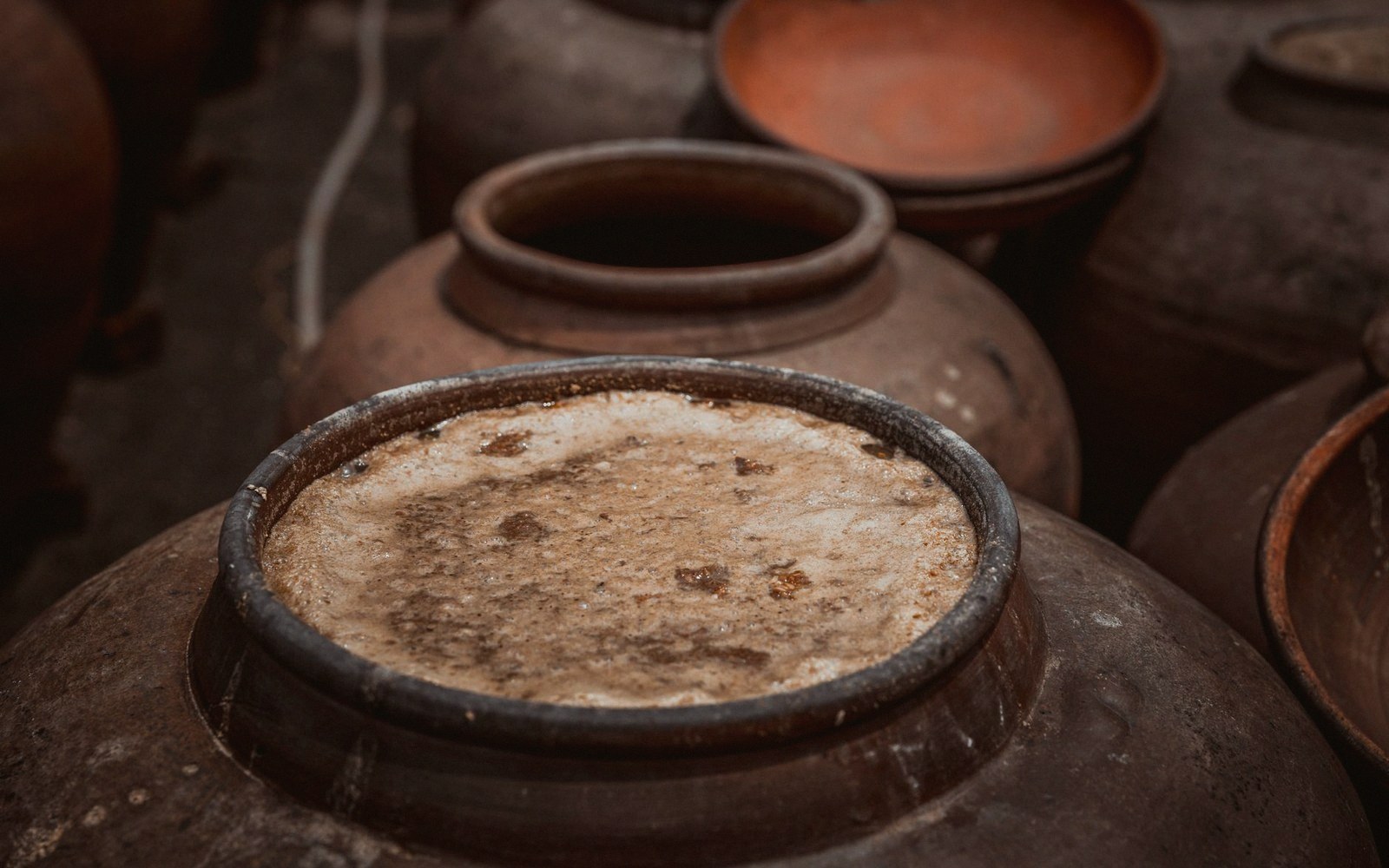
In the Andes, chicha de jora ferments in large clay vessels — tinajas — using wild yeasts resident on the dried maize itself and on the vessel walls. The process predates any European contact by millennia.
West Africa maintains multiple sorghum-based traditions — dolo in Burkina Faso and Mali chief among them — where the grain, water, and open air interact without pitched cultures. The women who brew dolo work with vessels and techniques that carry accumulated microbial populations across generations of production.
What these places share is not a biome but a practice: vessels, surfaces, and air left in intentional relationship long enough that the local microbiology stabilises into something repeatable.
The four documented traditions
- Lambic (Belgium)coolship fermentation in the Senne valley; seasonal October–April window; complex wild microbial consortium
- Sahti (Finland)resident microflora in wooden equipment; juniper-lined lauter tun; boundary between wild capture and carried culture
- Chicha de jora (Andes)fermentation in clay tinajas; wild yeasts on dried maize and vessel walls; pre-Columbian origin
- Dolo (Burkina Faso / Mali)sorghum-based open fermentation; brewed by women across generations; no pitched cultures