The Memory Problem That Institutions Solved
Most brewers in early medieval Europe were women working at domestic scale, producing ale for immediate consumption from grain that varied seasonally, water drawn from whatever source was available, and yeast carried implicitly on the equipment or harvested from a previous batch when conditions allowed. The knowledge that made a batch good — the temperature at which mashing worked best, the signs that told you fermentation was running clean, the herb proportions that preserved without overwhelming — lived in individual hands and accumulated over individual lifetimes. When a brewer died, or moved, or was sold as part of an estate, the knowledge moved or disappeared with her.
Monasteries were constitutively different. They were not immortal, but they were structured to behave as if they intended to be. A Benedictine house in the eighth century operated under a rule that regulated time, labour, diet, hospitality, and the management of agricultural resources, with the explicit goal of institutional perpetuation. The same community that built a kiln would expect to be using it in a hundred years. The same community that planted a hop garden would expect to harvest from it for generations. Individual monks died; the house continued; and the house's practices, encoded in written records, oral instruction, and the physical layout of the brewery itself, survived the individuals who had refined them.
This is a structural argument, not a spiritual one. Monasteries brewed better beer over time not because God favoured fermentation, but because they were among the very few institutions in early medieval Europe that possessed the organisational conditions under which brewing knowledge could accumulate rather than restart.
The conditions, at a glance
- Continuity of personnelcommunities outlasted individual practitioners, preventing knowledge loss at death or departure
- Fixed infrastructurestone kilns, dedicated cellars, hop gardens; investments only viable at multi-decade time horizons
- Written recordsbrew logs and agricultural notes enabled comparison across seasons and generations, not just within one lifetime
- Land ownershipcontrol of grain and hop cultivation allowed selective improvement that a market-dependent brewer could not attempt
- Labour stabilitya resident lay workforce provided consistent skilled hands across production seasons
What Accumulation Actually Required
Three things distinguished monastic brewing from its secular contemporaries: continuity of personnel, the capacity to invest in fixed infrastructure, and the keeping of written records. Secular equivalents — an aristocratic household, a market town's commercial brewer — might have one of these. Monasteries could maintain all three simultaneously, and this was decisive.
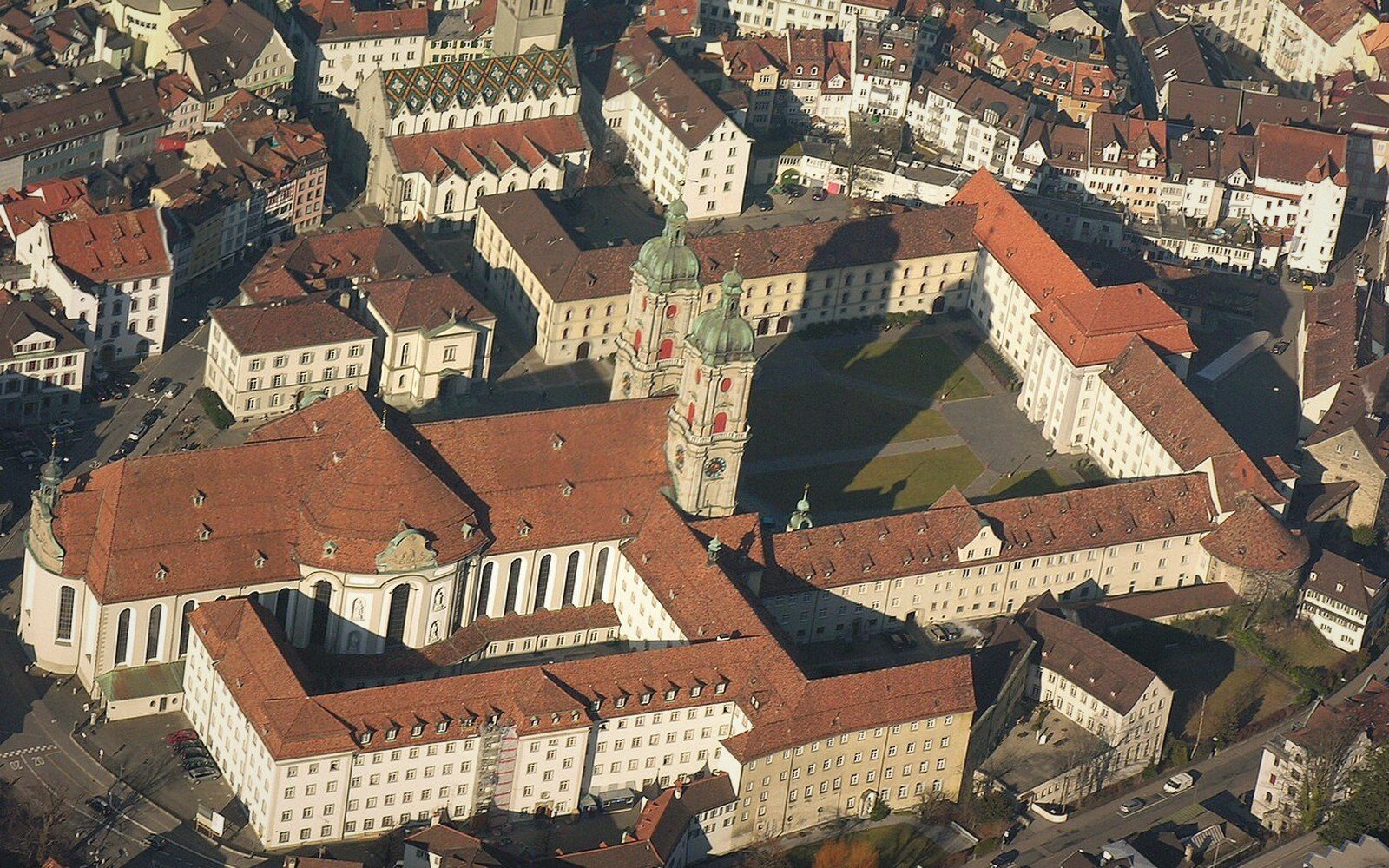
The St Gallen monastery plan, drawn up around 820, shows not one but three breweries on the same monastic site, differentiated by product and consumer — one for monks, one for distinguished guests, one for pilgrims and the poor. This is already a sophisticated operational distinction, and it implies a management layer capable of allocating grain, labour, fuel, and water across parallel production streams. A lone craftsperson cannot run three concurrent brewing operations; an institution with a literate administrative class and a stable workforce of novices and lay brothers can. The St Gallen plan is a design document, not a record of what was actually built, but it tells us something about how the problem of scale was being thought about in the Carolingian period.
Fixed infrastructure mattered in ways that are easy to underestimate. A properly constructed malt kiln — stone-built, with a flue and a stable heat source — produces more predictable malt than a makeshift structure dried over an open hearth. A dedicated fermentation cellar with consistent temperature and drainage enables greater control over what the yeast does than an improvised corner of a domestic building. The investment required to build these structures was substantial by early medieval standards, and it only made economic sense for an institution that expected to use them for decades. Monasteries made the investment; most secular producers did not, or could not. The infrastructure then shaped the knowledge: people who worked in a proper cellar learned what proper cellar conditions looked like, and that knowledge fed back into practice.
Written records did something different again. They created the possibility of comparison across time. A note in a brew log recording that the autumn batch was weak because the barley had been harvested damp is useful to the same brewer the following year. But that same note, reviewed by a cellarer thirty years later, forms part of a longer pattern — a pattern that individual memory cannot hold. Monastic libraries preserved agricultural and technical knowledge through the Carolingian period and beyond, and the habit of record-keeping that sustained theological and legal archives was available, at least in principle, to the management of a brewery.
Key episodes and references
- The St Gallen plan, c. 820Carolingian monastery design document showing three distinct breweries differentiated by product and intended drinker
- English dissolution, 1536–1541Henry VIII's seizure of monastic estates; the structural argument for what was lost alongside the physical assets
- Burton-on-Trent, Plzeň, Einbecksecular brewing towns whose later reputations traced partly to water chemistry first recognised through long residence on a site
The Economics of Patience
There is also a more direct economic argument. Monasteries were among the largest landholders in early medieval Europe, and land was the foundation of brewing. They controlled grain production on their own estates, which meant they could manage variety selection, growing conditions, and harvest timing in ways that a brewer buying from a market could not. They could maintain dedicated hop gardens — when hops came into common use, from roughly the twelfth or thirteenth century in continental Europe and later in Britain — and observe over many growing seasons which varieties performed best in their local soil and climate. They had the labour to do it: a monastic community included not just monks but extensive lay workforces bound to the estate.
This combination of land, labour, and institutional patience meant that monasteries could undertake improvement projects that had no short-term payoff. Selective cultivation of a better barley strain, or the careful propagation of a particularly clean ferment, returns nothing in year one and perhaps little in year three. But over a generation of consistent selection, the results compound. The secular brewer working season to season, dependent on purchased inputs and uninsured against a bad harvest, could not afford the lag time. The monastery could.
Water is another example. The chemistry of brewing water — its hardness, mineral content, and interaction with mash pH — was not understood in terms that a medieval brewer would have recognised, but the experiential knowledge that a particular well or spring made better beer than another was entirely accessible. A community resident on the same site for centuries would accumulate that knowledge and act on it: choosing water sources, building infrastructure to reach them, noticing when a change in source changed the beer. The famous brewing towns of later medieval and early modern Europe — Burton-on-Trent, Plzeň, Einbeck — owed their reputations substantially to water chemistry, and in most cases the initial recognition of that advantage came through exactly this kind of multi-generational experiential knowledge rather than any theoretical understanding.
What Transfers, What Disappears
The monastic brewing tradition did not survive the Reformation intact. In England, the dissolution of the monasteries between 1536 and 1541 under Henry VIII transferred enormous landholdings and physical infrastructure to secular ownership in a matter of years. The physical buildings could be occupied; the knowledge embedded in their communities could not be so easily carried away. Some lay brewers who had worked in monastic settings took skills with them. Recipes and notes survived in some cases through the libraries that were partially preserved or transferred. But the organisational structure that had made the knowledge cumulative — the community, the written culture, the long-term land management, the institutional patience — was simply gone.
This is where the argument about institutional continuity bites hardest. The knowledge that monasteries accumulated was not the kind that can be fully extracted and written down as a set of instructions. It was partly tacit, embedded in the feel of a mash, the look of a ferment, the smell of a cellar in good condition. That kind of knowledge requires an unbroken chain of practice to transmit. Dissolve the chain, and you lose not just what the last practitioner knew, but the compounded improvements of every practitioner before them.
What survives of the monastic brewing tradition is therefore uneven. In Belgium and parts of Germany and Austria, where dissolution came later, more gradually, or not at all for certain houses, institutional continuity persisted long enough for practice to remain genuinely connected to its medieval roots. The Trappist brewing houses that still operate today — Westvleteren, Westmalle, Chimay among others — are not ancient foundations in most cases; they were established or re-established in the nineteenth century. But they operate under the same fundamental logic: institutional permanence, reinvestment of resources into the brewery, a time horizon that commercial operations structurally cannot match.
The romantic version of monastic brewing attributes its quality to prayer, dedication, or some mystical connection between religious vocation and fermentation. The actual explanation is more interesting and more transferable: institutions that cannot be bought out, do not need to show a return this quarter, own their input supply chains, keep written records, and expect to exist in a hundred years will, over time, produce better and more consistent beer than institutions that lack those properties. The monastery was not a special case. It was just one of the very few organisational forms available in early medieval Europe that could afford to wait long enough for knowledge to compound.
The beer improved because the institution survived, and the institution survived because it was structured to do nothing else.